
EUDR explained
EU Deforestation Regulation (EUDR): requirements and deadlines
Regulation (EU) 2023/1115 stops seven commodities and the products made from them being placed on the EU market or exported unless they are deforestation free, produced legally in the country of production and covered by a due diligence statement. This page explains what the law requires, who must comply and from when, with the article references.
in scope: cattle, cocoa, coffee, oil palm, rubber, soya, wood
EUDR applies to operators and traders
records to keep after each due diligence statement (Art. 12)
Key dates
Regulation (EU) 2023/1115 in force, no obligations yet.
Delegated Regulation (EU) 2026/2102 narrows and clarifies the product list.
Obligations apply to operators of any size, except micro and small operators established by 31 December 2024, and to downstream operators and traders of any size. Products added to Annex I follow from 30 December 2027.
Same obligations, six months later.
Soluble coffee, frozen cattle tongues, toilet soap containing palm oil and further palm oleochemicals.
The dates moved twice. Regulation (EU) 2024/3234 postponed the original dates by one year, and Regulation (EU) 2025/2650, in force since 26 December 2025, postponed them again and simplified parts of the regime. The dates above are the ones now in the law, not a proposal.
Does the EUDR apply to my company?
If you place on the EU market, export or resell inside the EU a product listed in Annex I that is made from cattle, cocoa, coffee, oil palm, rubber, soya or wood, the EUDR applies to you. What changes is how much work it is, and that depends on where you sit in the chain.
Operator
You place the product on the EU market for the first time, or you export it.
Obligations:
Due diligence, full or simplified, and a due diligence statement before placing on the market or exporting. One statement can cover several shipments within one year.
Trader or downstream operator
Someone upstream has already filed for the product you buy, handle or resell.
Obligations:
No DDS; collect reference numbers where the supplier is an operator, keep records five years, act on substantiated concerns.
Micro or small operator
Being a micro or small company alone does not give you until 2027.
Obligations:
Same obligations as an operator. Your date moves to 30 Jun 2027 only if all three apply: you place products on the market yourself, you were a micro or small undertaking by 31 December 2024, and you handle no timber products on the old EUTR list.
EUDR Obligations Checker:
Answer a few questions, get an instant assessment of your EUDR obligations.
Built by compliance experts
What the law requires, article by article
Obligations under Regulation (EU) 2023/1115, the EU Deforestation Regulation.
Collect
What the law requires (Art. 9):
Gather product, supplier and geolocation data for every plot before goods are placed on the EU market.
Assess
What the law requires (Art. 10, Art. 13):
Assess the risk of non-compliance across all four risk chapters. Simplified due diligence can apply where all commodities come from low-risk countries and the risk of circumvention or mixing is negligible.
Resolve
What the law requires (Art. 11):
Where risk is not negligible, take risk mitigation measures until it is, such as extra documents, supplier checks or audits.
File
What the law requires (Art. 4):
Submit a due diligence statement in the EU Information System before placing products on the market and keep the reference number.
Keep records
What the law requires (Arts. 4(3), 9(1), 12(5)):
Keep due diligence statements and supporting evidence for five years and show them to authorities on request.
Downstream and traders
What the law requires (Art. 4, Art. 5):
Downstream operators and traders collect the reference numbers of the due diligence statements of suppliers that are operators, and keep them.
EUDR Passport: From the obligation to a working process
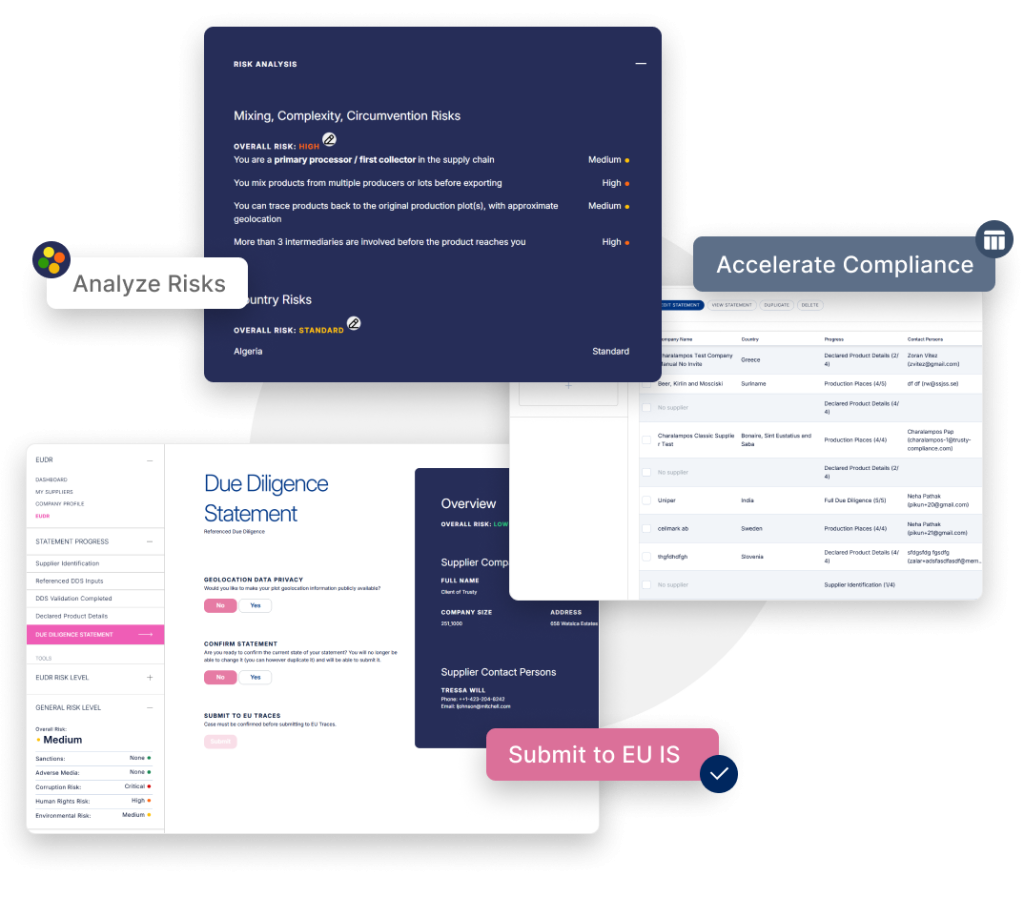
Trusty’s EUDR Passport turns these obligations into a repeatable process: collect, assess, resolve, file and keep records in one place.
What happens if you do not comply with the EUDR
Member States must provide for maximum fines of at least 4% of a company’s annual EU-wide turnover (Art. 25(2)(a) of Regulation (EU) 2023/1115). The fine is one of several consequences that competent authorities can apply, and the burden of proof sits with the company.
- Confiscation of the products concerned, and of the revenues gained from them.
- Temporary exclusion from public procurement and from access to public funding.
- Products without a valid due diligence statement cannot clear customs, so a missing or wrong statement stops the shipment before any fine is discussed.
Frequently asked questions
EUDR compliance depends on your role in the supply chain and your company size.
Operators are any natural or legal persons who, in the course of a commercial activity, place relevant products on the EU market for the first time or export them. This includes importers, EU-based producers (farmers, forest owners), and exporters. Operators bear the heaviest obligations: they must exercise due diligence (full, or simplified where Article 13 applies) and submit a Due Diligence Statement (DDS) to the EU Information System before placing the products on the market or exporting them. One DDS can cover several shipments placed within one year of submission, for the quantity declared.
Downstream operators are persons who place on the EU market or export relevant products made from inputs already covered by an upstream DDS or simplified declaration. Examples: a chocolate manufacturer buying cocoa from an importer, or a furniture maker buying imported timber. Their obligations are set out in Article 5 and do not include submitting a DDS or exercising due diligence.
Traders are persons who make relevant products already on the EU market available to other parties, resellers, distributors, and wholesalers who buy and sell without placing the product on the market for the first time. Their obligations are also set out in Article 5 and mirror those of downstream operators. Neither downstream operators nor traders submit a DDS, regardless of company size. Large (non-SME) downstream operators and traders have two additional obligations compared to SMEs: they must register in the EUDR Information System before trading, and must verify upstream due diligence if substantiated concerns arise.
The seven regulated commodities are: cattle, cocoa, coffee, palm oil, rubber, soy, and wood, along with a broad range of derived products including chocolate, wooden furniture, paper, and many others listed in Annex I of the Regulation. The product list was amended by a Commission Delegated Regulation adopted in July 2026 (see the dedicated question below): cattle hides, skins and leather, conveyor and transmission belts, other articles of vulcanised rubber, and retreaded and used tyres were removed from the scope, while soluble coffee, toilet soap containing palm oil and several palm oleochemicals will enter the scope on 30 December 2027.
Company size matters less than you think. Operators must comply from 30 December 2026. Micro and small operators established as such by 31 December 2024, and natural persons, have until 30 June 2027, except for timber products listed in the Annex to the EU Timber Regulation. Downstream operators and traders of any size must comply from 30 December 2026. Many micro and small companies do not qualify and must also be ready by 30 December 2026. If in doubt, plan for 30 December 2026.
One important but frequently misunderstood exemption concerns own use. Businesses that buy relevant products already placed on the EU market and use them exclusively in their own operations, without supplying them to others, are not covered by the Regulation. The same applies to businesses that produce relevant products themselves and consume them entirely internally (a farmer feeding home-grown soy to their own livestock, for example). However, the exemption does not extend to importing: a company that imports relevant products into the EU is an operator that must exercise due diligence (full, or simplified where Article 13 applies) and submit a DDS, even if the products are used purely internally, because the customs release for free circulation itself constitutes placing on the market.
Commission Delegated Regulation (EU) 2026/2102 amends Annex I of the EUDR, the list of relevant products. The Commission adopted it on 13 July 2026; it was published in the Official Journal on 17 September 2026 and has been in force since 18 September 2026. The removals apply now; the additions apply from 30 December 2027.
Removed from the scope: cattle hides, skins and leather (HS 4101, 4104, 4107); conveyor and transmission belts (HS 4010) and other articles of vulcanised rubber (HS 4016); retreaded and used tyres (HS 4012), with only tyre treads remaining in scope (ex 4012 90 30); soya beans for sowing; and aircraft and motor vehicle seats, with the seats entry narrowed to seats made of wood.
Added to the scope, applying from 30 December 2027: soluble coffee, meaning extracts, essences and concentrates of coffee (HS 2101 11); frozen cattle tongues (HS 0206 21); toilet soap containing palm oil (HS 3401 11 00); and a set of palm derived oleochemicals used in products such as paints, coatings, lubricants, detergents and food additives. Where a palm entry states it, products used in the manufacture of medicinal products for human or veterinary use are excluded.
Clarified: the Regulation applies only to cattle of the genus Bos, so buffalo and bison are excluded; only to natural rubber from Hevea brasiliensis, so synthetic rubber, balata, gutta-percha and similar gums are excluded; only to oil palm of Elaeis species, so babassu oil is excluded; and wood products are out of scope to the extent they are made of bamboo, rattan or similar woody materials. General exclusions apply only to waste within the meaning of Directive 2008/98/EC, product samples of negligible value and products consumed in examination, analysis or testing. The exclusions for used and second-hand products, packaging, marketing and information materials accompanying a product or supplied free of charge, and items of correspondence apply only to the Annex I entries that state them.
For businesses, the practical takeaways are twofold. If your only EUDR exposure was leather, rubber belts, other articles of vulcanised rubber or retreaded and used tyres, you may now be out of scope entirely. Conversely, if you trade soluble coffee, toilet soap containing palm oil or palm oleochemicals, you need to be ready for compliance by 30 December 2027.
No, but they can meaningfully simplify the due diligence process.
Certifications such as FSC (Forest Stewardship Council) and PEFC (Programme for the Endorsement of Forest Certification) are valuable evidence of sustainable and legal sourcing, but they do not fulfil the EUDR's mandatory requirements by themselves. The Regulation requires operators to collect specific plot-level geolocation data for every production origin and to submit a Due Diligence Statement to the EU Information System; steps that no certification scheme currently replaces.
Where certifications do help is in the risk assessment phase. Under Article 10 of the Regulation, operators must assess the risk that a product is not deforestation-free or not legally produced. Certification schemes contribute to that assessment in several concrete ways:
- Legal compliance documentation. FSC and PEFC require certified operators to comply with national and local laws governing forest use, tenure rights, and environmental protection. This documented legal compliance directly supports the legality limb of the EUDR risk assessment.
- Chain of custody traceability. FSC's chain-of-custody certification provides a documented, audited record of how material moves through the supply chain, reducing the burden of gathering raw supply chain information from scratch.
- Evidence of sustainable forest management. Both schemes require management plans, harvest limits, and independent audits. This evidence can support a conclusion that the risk of deforestation or forest degradation is negligible. It does not change the type of due diligence: simplified due diligence depends only on whether all origins are in low-risk countries (Art. 13), not on certification.
- Reduced residual risk. Where a product is sourced from a certified forest in a low-risk country, the combination of certification and country classification substantially narrows the scope of additional verification an operator needs to perform.
In practice, operators with certified supply chains should still collect geolocation coordinates and submit their DDS. Certification can make completing due diligence easier because it supplies part of the evidence, but it does not replace due diligence.
Yes, under updated guidance issued in April 2025, operators have more flexibility than the original Regulation text implied.
A single DDS can cover several shipments of the declared quantity placed on the market within one year of submission, provided due diligence covers the whole quantity. This allows operators who make regular, repeat purchases from the same supplier to file an annual or periodic DDS rather than a separate statement for each consignment, a significant reduction in administrative burden for high-frequency traders and importers.
A DDS can also cover multiple products within the same submission. The Regulation does not restrict a DDS to a single commodity type; what matters is that the DDS includes all the information required under Article 9 for every product and commodity it covers. A single DDS can therefore cover a consignment containing both cocoa products and soy products, or both crude and refined palm oil from the same plantation, as long as geolocation coordinates, quantities, and production origins are fully documented for each relevant product covered.
Re-imported goods already covered by a statement, such as customer returns, cite the existing reference number in the customs declaration.
One statement can cover products from several countries of production, provided it lists every country and due diligence covers each origin. The DDS must still accurately reflect the actual products, quantities, origins, and geolocation data for everything it covers.
The starting point is the product's classification in Annex I. Every relevant product is listed in Annex I under one relevant commodity, and the due diligence obligation extends to that commodity.
For bulk-traded commodities such as soy or palm oil, the operator must ensure that all plots of land involved in a shipment are identified and that the commodities are never mixed, at any step of the supply chain, with commodities of unknown origin or from areas deforested or degraded after 31 December 2020. Mass balance chains of custody are not permitted: compliant material must remain segregated from non-compliant or unknown material throughout. Full identity preservation is not required, but segregation is. If non-compliant material cannot be separated out, the entire batch becomes non-compliant.
For composite products made from one relevant commodity, such as wooden furniture assembled from components originating in different forests, the operator must geolocate all the plots of land where the commodity was produced. No component may be of unknown origin or come from land deforested or degraded after the cut-off date.
For composite products containing several different relevant commodities, the Commission's updated FAQ (April 2025) provides an important simplification: due diligence is conducted only on the commodity under which the product is listed in Annex I. A chocolate bar (HS 1806) is listed under cocoa, so the due diligence and information requirements extend to the cocoa powder and cocoa butter it contains, but not to the palm oil or soy lecithin that may also be present. This resolves what many manufacturers had feared would be a layered, ingredient-by-ingredient compliance exercise.
The practical approach for manufacturers is to identify the Annex I classification of each finished product, determine which commodity drives the due diligence obligation, and work with suppliers to obtain geolocation and compliance data for that commodity, ideally through platforms that allow suppliers to store and share the data across multiple buyer relationships.
The two concepts are related but legally distinct, and the distinction has direct consequences for how you conduct due diligence depending on which commodity you handle.
Deforestation means the conversion of forest to agricultural use, whether human-induced or not, after 31 December 2020, the Regulation's reference date (Art. 2(3)). A plot of land that was forest on that date and has since been cleared for cattle pasture, a cocoa plantation, or a soy field is considered deforested. Products linked to that land cannot be placed on the EU market.
Forest degradation means structural changes to forest cover that take the form of converting primary forests or naturally regenerating forests into plantation forests or into other wooded land, or converting primary forests into planted forests (Art. 2(7)).
Why the distinction matters for compliance:
For most EUDR commodities, cattle, cocoa, coffee, palm oil, rubber, and soy, the Regulation requires only that products be deforestation-free. Demonstrating that production land was not converted from forest to agricultural use after the reference date is sufficient.
For wood and wood-derived products, the Regulation applies a stricter standard. The "deforestation-free" concept is defined more broadly for wood: under Article 2(13), a wood product is only deforestation-free if the wood was harvested without inducing forest degradation after 31 December 2020, in addition to the land not having been deforested. Forest degradation is therefore built into the deforestation-free definition for wood, not a separate parallel requirement. The practical effect is the same: a timber operator sourcing from a forest that has undergone degradation, even if the land remains classified as forest, cannot lawfully place that wood on the EU market.
In practical due diligence terms, this means operators handling wood products must assess both the conversion history of production land and the management practices applied to it, using satellite monitoring data, forest management plans, and independent assessments as evidence. Operators in other commodity sectors need only address the conversion/deforestation question.
The MSPO designation was introduced by the December 2025 amendment to the Regulation as a targeted relief measure for small-scale producers who face disproportionate compliance burdens.
An operator qualifies as an MSPO if they meet all three of the following conditions:
- Size. They are a natural person, a micro-undertaking or a small undertaking under Directive 2013/34/EU. A micro-undertaking does not exceed at least two of these three limits: balance sheet €450,000, net turnover €900,000, 10 employees. A small undertaking does not exceed at least two of these limits: balance sheet €5 million, net turnover €10 million, 50 employees.
- Country of establishment. They must be established in a country classified as low risk under the EUDR country benchmarking system (Article 29). This covers the majority of countries, including all EU Member States and most of Europe, as well as many agricultural-producing nations. Standard and high-risk countries are excluded.
- Self-production. The operator must have personally grown, harvested, raised, or otherwise produced the relevant products on their own plots of land or establishments located in that low-risk country. Operators who source from third-party producers, even if they are small, do not qualify. This is the critical distinction: MSPO status is reserved for primary producers acting as their own supply chain.
A small Finnish forest owner who sells timber from his own forest, for example, would qualify. A small company that buys timber from Finnish forest owners and sells it on would not.
MSPOs benefit from a substantially lighter compliance regime compared to standard operators.
MSPOs are released from submitting due diligence statements, not from exercising due diligence. Instead of due diligence statements, an MSPO submits a one-time simplified declaration to the EU Information System (Article 4a). The declaration contains the operator and product information and, for the plots of land or establishments, the geolocation or, alternatively, the postal address.
This reflects the policy rationale: a small farmer producing on their own land in a low-risk country is the origin of the supply chain, not a link in it. The risk that their product is not deforestation-free is inherently lower and more directly verifiable from the land itself. Requiring them to file the same statements as a large multinational importer would be disproportionate.
The simplified declaration filed by an MSPO is not just a personal compliance document; it becomes a reference document in the broader supply chain. The MSPO is required to pass the simplified declaration identifier to downstream operators and traders they supply, and those parties collect and retain it as part of their own Article 5 supply chain documentation, in the same way they would record a full upstream DDS reference number.
A downstream operator is a person who, in the course of a commercial activity, places on the EU market or exports relevant products made from inputs that are all already covered by an upstream DDS or simplified declaration (Article 2(15b) EUDR). Examples include a furniture manufacturer buying timber that an importer has cleared with a DDS, or a food producer using cocoa butter that a processor placed on the market.
Downstream operators' obligations are set out in Article 5 of the Regulation. Crucially, downstream operators are not required to submit a DDS, exercise due diligence, or verify that due diligence was carried out upstream (except in specific circumstances described below).
The core obligations applying to all downstream operators, regardless of size, are:
Collect and keep supply chain information (Article 5(3) and (4)): before trading, obtain and retain the name, address, email and web address of direct upstream suppliers and downstream customers, for at least five years. If the direct upstream supplier is an operator (the party who first placed the product on the market), also collect the DDS reference number or simplified declaration identifier they are required to pass on. If the supplier is itself a downstream operator, contact information is sufficient.
Notify immediately on non-compliance risk (Article 5(5)): if you become aware of information, including substantiated concerns, that a product you have placed or made available may not comply, immediately inform the competent authority and all downstream parties you supplied. For exports, also notify the competent authority of the country of production.
Large (non-SME) downstream operators have two additional obligations. They must register in the EUDR Information System before placing or making available or exporting for the first time (Article 5(2)). And if substantiated concerns arise about a product's compliance, they must verify that due diligence was exercised upstream and that no or only a negligible risk was found, and must not continue trading the product unless the verification passes (Article 5(6)). This is a reactive obligation triggered by specific concerns, not a standing requirement to review all upstream supply chains.
Traders are persons who make relevant products already on the EU market available to other parties: resellers, distributors, and wholesalers who are not the first to place the product on the market and do not export it. Their obligations are set out in Article 5 of the Regulation, alongside those of downstream operators.
No trader, large or small, is required to submit a DDS or exercise due diligence. This is the most important thing to understand about trader obligations, and it marks a significant difference from the obligations of operators.
The core obligations applying to all traders, regardless of size, are:
Collect and keep supply chain information (Article 5(3) and (4)): before trading, obtain and retain the name, address, email and web address of direct upstream suppliers and downstream customers, for at least five years. If the direct upstream supplier is an operator (the party who first placed the product on the market), also collect the DDS reference number or simplified declaration identifier they are required to pass on. If the supplier is itself a downstream operator or trader, contact information is sufficient.
Notify immediately on non-compliance risk (Article 5(5)): if you become aware of information, including substantiated concerns, that a product you have made available on the market may not comply, immediately inform the competent authority and all downstream parties you supplied.
Large (non-SME) traders have two additional obligations compared to SMEs. They must register in the EUDR Information System before making products available for the first time (Article 5(2)). And if substantiated concerns arise about a product's compliance, they must verify that due diligence was exercised upstream and that no or only a negligible risk was found, and must not continue making the product available unless the verification passes (Article 5(6)). This verification obligation is reactive, not proactive: it is triggered by specific concerns, not by the act of trading itself.
Yes, and in practice this is one of the Regulation's most important enforcement mechanisms.
Under Article 5(1), downstream operators and traders may only place, make available, or export relevant products if they are in possession of the information required under Article 5(3). Where their direct upstream supplier is an operator, that information includes the DDS reference number or simplified declaration identifier. If the operator has not provided it, the downstream operator or trader cannot lawfully trade those products.
Critically, downstream operators and traders cannot resolve this gap by submitting their own DDS. That option is not available to them under the Regulation. Their only choices are to obtain the required reference number from the upstream operator, or to decline the purchase.
This dynamic creates strong commercial pressure throughout the supply chain. Downstream operators and traders have a direct financial incentive to require DDS compliance from their upstream operators, because their own ability to trade depends on it. Products that enter the downstream supply chain without a valid DDS reference number from the upstream operator cannot move further along the chain until the gap is remedied.
All content reflects Regulation (EU) 2023/1115 as consolidated on 18 September 2026, the Commission’s Guidance Document and FAQ (5th iteration, April 2026), and Commission Delegated Regulation (EU) 2026/2102 amending Annex I. This text is for informational purposes and does not constitute legal advice. For specific compliance questions, consult the full text of the Regulation and seek qualified legal counsel.
Latest EUDR compliance articles
EUDR and wood: which harvest dates are in scope
Two fixed dates, not the age of the wood, decide whether your furniture, paper or packaging needs a due diligence…
EUDR and PPWR: What importers need to know about both
The EU's deforestation and packaging regulations reach the same shipments from different angles. Here is what each requires and how…
EUDR countdown: A 10-week checklist before 30 December 2026
The EUDR applies from 30 December 2026, about ten weeks from now, to operators and to downstream operators and traders…