
Free EUDR obligations checker: your duties in seconds
What are my EUDR obligations?
Our free EUDR obligations checker gives you the answer in under two minutes. If your company places on the EU market, exports or resells inside the EU a product listed in Annex I of the EU Deforestation Regulation (2023/1115) that is made from one of the seven covered commodities (cattle, cocoa, coffee, oil palm, rubber, soya or wood), the Regulation applies. Operators must ensure the product is deforestation-free, legally produced and covered by a due diligence statement with the geolocation of the plots of origin; downstream operators and traders have lighter obligations.
Your exact duties depend on whether you are an operator or a trader, and on your company size. The fastest way to find out what applies to you is to run the EUDR obligations checker below. It takes under 2 minutes.
Visit our EUDR Passport page to discover how we make EUDR compliance simple.
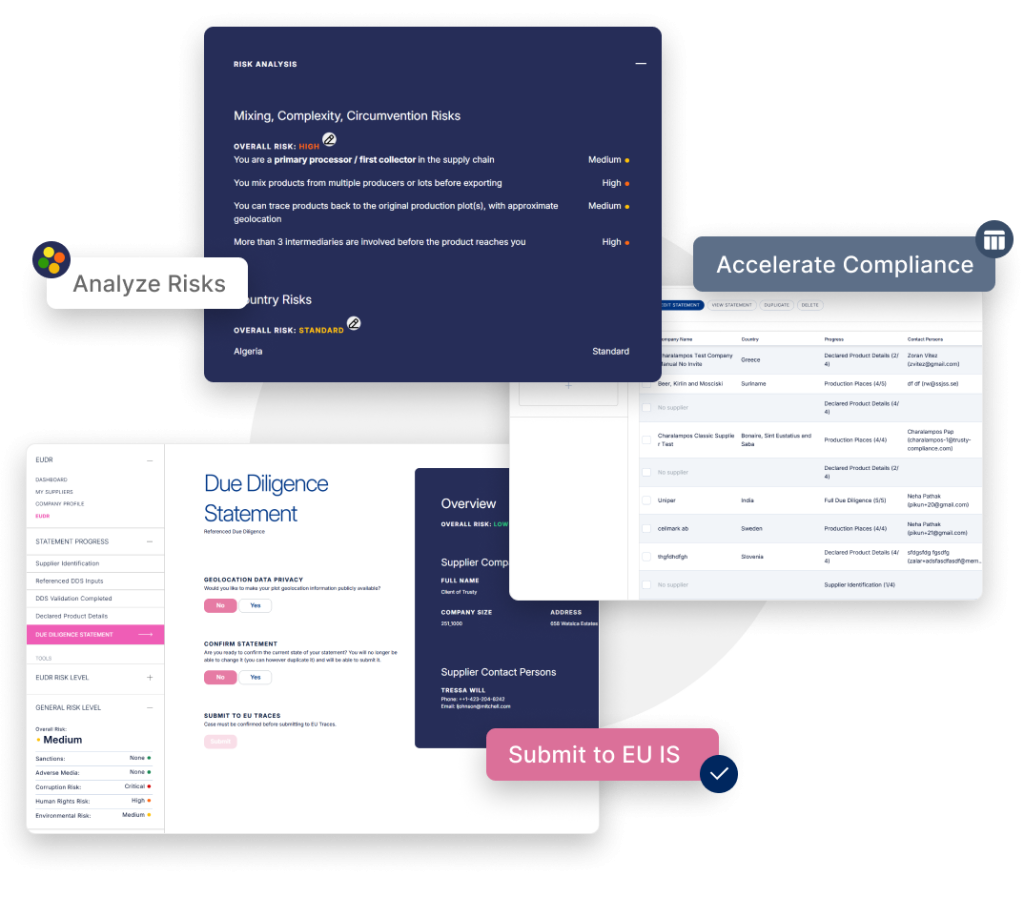
What to do with your result: set it up in EUDR Passport
The EUDR checker tells you what the law expects of you. EUDR Passport is where you do it.
FREE TO SET UP
Product Profiles, supplier onboarding and data collection at no cost.
ONE PRICE PER PRODUCT
From €90 per product per year, unlimited due diligence statements included, 12 months of monitoring.
FILED TO TRACES
Statements generated from the profile and filed to the EU Information System (TRACES) for you.
Frequently asked questions
The EUDR Obligations Checker is a free, no-sign-up tool that helps your business find out whether the EU Deforestation Regulation (Regulation (EU) 2023/1115) applies to you, and exactly what your obligations are. In a few simple questions, you will learn which role you fall under (operator, trader, downstream operator, or micro/small primary operator), which of the seven regulated commodities affect you, and whether you need to submit a Due Diligence Statement (DDS) to the EU Information System.
EUDR compliance depends on your role in the supply chain and your company size.
Operators are any natural or legal persons who, in the course of a commercial activity, place relevant products on the EU market for the first time or export them. This includes importers, EU-based producers (farmers, forest owners), and exporters. Operators bear the heaviest obligations: they must exercise due diligence (full, or simplified where Article 13 applies) and submit a Due Diligence Statement (DDS) to the EU Information System before placing the products on the market or exporting them. One DDS can cover several shipments placed within one year of submission, for the quantity declared.
Downstream operators are persons who place on the EU market or export relevant products made from inputs already covered by an upstream DDS or simplified declaration. Examples: a chocolate manufacturer buying cocoa from an importer, or a furniture maker buying imported timber. Their obligations are set out in Article 5 and do not include submitting a DDS or exercising due diligence.
Traders are persons who make relevant products already on the EU market available to other parties, resellers, distributors, and wholesalers who buy and sell without placing the product on the market for the first time. Their obligations are also set out in Article 5 and mirror those of downstream operators. Neither downstream operators nor traders submit a DDS, regardless of company size. Large (non-SME) downstream operators and traders have two additional obligations compared to SMEs: they must register in the EUDR Information System before trading, and must verify upstream due diligence if substantiated concerns arise.
The seven regulated commodities are: cattle, cocoa, coffee, palm oil, rubber, soy, and wood, along with a broad range of derived products including chocolate, wooden furniture, paper, and many others listed in Annex I of the Regulation. The product list was amended by a Commission Delegated Regulation adopted in July 2026 (see the dedicated question below): cattle hides, skins and leather, conveyor and transmission belts, other articles of vulcanised rubber, and retreaded and used tyres were removed from the scope, while soluble coffee, toilet soap containing palm oil and several palm oleochemicals will enter the scope on 30 December 2027.
Company size matters less than you think. Operators must comply from 30 December 2026. Micro and small operators established as such by 31 December 2024, and natural persons, have until 30 June 2027, except for timber products listed in the Annex to the EU Timber Regulation. Downstream operators and traders of any size must comply from 30 December 2026. Many micro and small companies do not qualify and must also be ready by 30 December 2026. If in doubt, plan for 30 December 2026.
One important but frequently misunderstood exemption concerns own use. Businesses that buy relevant products already placed on the EU market and use them exclusively in their own operations, without supplying them to others, are not covered by the Regulation. The same applies to businesses that produce relevant products themselves and consume them entirely internally (a farmer feeding home-grown soy to their own livestock, for example). However, the exemption does not extend to importing: a company that imports relevant products into the EU is an operator that must exercise due diligence (full, or simplified where Article 13 applies) and submit a DDS, even if the products are used purely internally, because the customs release for free circulation itself constitutes placing on the market.
Company size matters less than you think. Operators must comply from 30 December 2026. Micro and small operators established as such by 31 December 2024, and natural persons, have until 30 June 2027, except for timber products listed in the Annex to the EU Timber Regulation. Downstream operators and traders of any size must comply from 30 December 2026. Many micro and small companies do not qualify and must also be ready by 30 December 2026. If in doubt, plan for 30 December 2026.
Commission Delegated Regulation (EU) 2026/2102 amends Annex I of the EUDR, the list of relevant products. The Commission adopted it on 13 July 2026; it was published in the Official Journal on 17 September 2026 and has been in force since 18 September 2026. The removals apply now; the additions apply from 30 December 2027.
Removed from the scope: cattle hides, skins and leather (HS 4101, 4104, 4107); conveyor and transmission belts (HS 4010) and other articles of vulcanised rubber (HS 4016); retreaded and used tyres (HS 4012), with only tyre treads remaining in scope (ex 4012 90 30); soya beans for sowing; and aircraft and motor vehicle seats, with the seats entry narrowed to seats made of wood.
Added to the scope, applying from 30 December 2027: soluble coffee, meaning extracts, essences and concentrates of coffee (HS 2101 11); frozen cattle tongues (HS 0206 21); toilet soap containing palm oil (HS 3401 11 00); and a set of palm derived oleochemicals used in products such as paints, coatings, lubricants, detergents and food additives. Where a palm entry states it, products used in the manufacture of medicinal products for human or veterinary use are excluded.
Clarified: the Regulation applies only to cattle of the genus Bos, so buffalo and bison are excluded; only to natural rubber from Hevea brasiliensis, so synthetic rubber, balata, gutta-percha and similar gums are excluded; only to oil palm of Elaeis species, so babassu oil is excluded; and wood products are out of scope to the extent they are made of bamboo, rattan or similar woody materials. General exclusions apply only to waste within the meaning of Directive 2008/98/EC, product samples of negligible value and products consumed in examination, analysis or testing. The exclusions for used and second-hand products, packaging, marketing and information materials accompanying a product or supplied free of charge, and items of correspondence apply only to the Annex I entries that state them.
For businesses, the practical takeaways are twofold. If your only EUDR exposure was leather, rubber belts, other articles of vulcanised rubber or retreaded and used tyres, you may now be out of scope entirely. Conversely, if you trade soluble coffee, toilet soap containing palm oil or palm oleochemicals, you need to be ready for compliance by 30 December 2027.
Building your account and Product Profiles is free.
The risk assessment is from €90 per product profile per year, with the due diligence statement filed to TRACES included.
If a risk is flagged, Resolve Essential costs €290 per year per product profile for plot-level risks, Resolve Complete €490 per year when country risk or supply-chain complexity is flagged. Downstream operators and traders pay €75 per year for the first product profile per supplier and €25 for each additional profile with the same supplier. Prices exclude VAT.
All content reflects Regulation (EU) 2023/1115 as consolidated on 18 September 2026, the Commission’s Guidance Document and FAQ (5th iteration, April 2026), and Commission Delegated Regulation (EU) 2026/2102 amending Annex I. This text is for informational purposes and does not constitute legal advice. For specific compliance questions, consult the full text of the Regulation and seek qualified legal counsel.